
Introduction
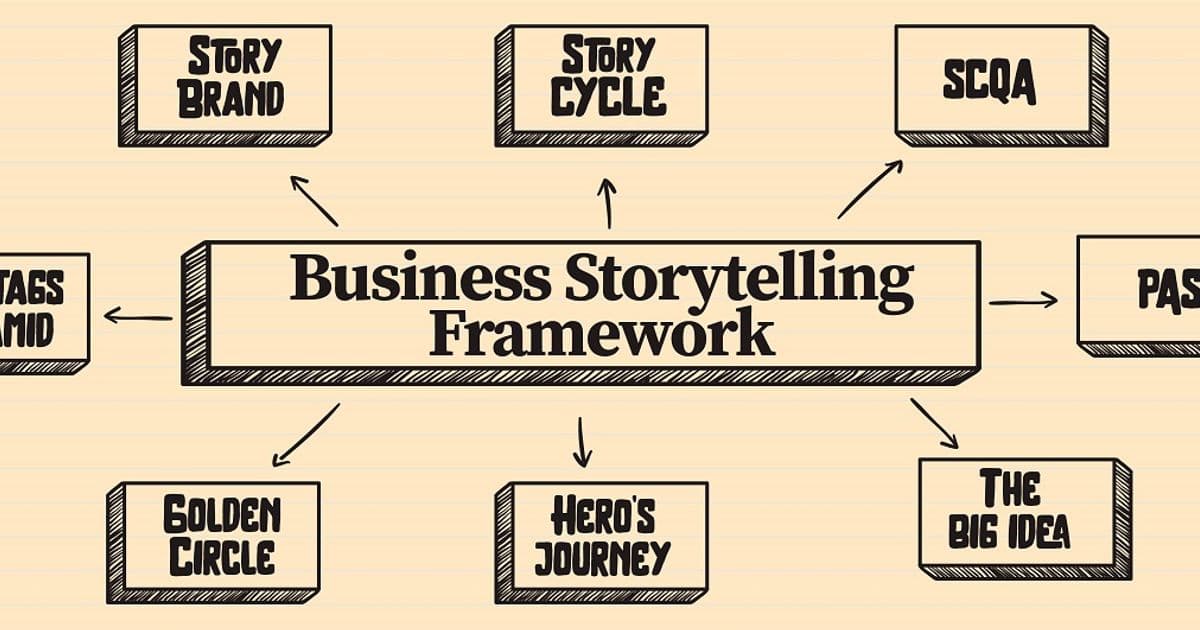
Storytelling is an important aspect of successful business communication, allowing brands to build stronger emotional relationships with their audiences. Businesses can improve their communication, promotion, and engagement strategies by using structured storytelling frameworks. In business, storytelling goes beyond just entertaining people - it also creates connections, communicates brand values, and encourages action. Being proficient in these storytelling frameworks can greatly influence the way messages are delivered, whether it's to investors or customers. This article will delve into important business storytelling frameworks that can transform your approach.
The Hero’s Journey
The Hero’s Journey, a storytelling format created by Joseph Campbell, is a narrative pattern that resonates with our personal life experiences. Comprehending this structure can offer valuable perspectives for constructing your narratives, whether you're recounting the genuine history of your business or creating a made-up story. The Hero's Journey is a well-known storytelling framework that portrays a hero - typically symbolizing your customer - as they navigate through a life-changing journey. This model is particularly efficient for demonstrating how your product or service can assist clients in overcoming obstacles and attaining success.
10 Stages of the Hero’s Journey
- Ordinary World: Your customer’s current situation or problem.
- Call to Adventure: The realization of a need or a challenge.
- Refusal of the Call: Initial hesitation or skepticism.
- Meeting the Mentor: Introduction of your product/service as the guiding solution.
- Crossing the Threshold: The customer commits to trying the solution.
- Trials and Tests: Obstacles along the way, with your product providing support.
- Approach: The customer nears their biggest obstacle.
- Ordeal: The most significant challenge is faced and conquered.
- Reward: The customer achieves success or transformation.
- Return to the Ordinary World: The customer returns to their routine, but better than before.
Application in business
Present your customer as the main character and your brand as the mentor leading them towards achieving their goals. Consider how a skincare brand could narrate the journey of an individual facing acne issues (Ordinary World), before coming across the brand's acne-treatment items (Meeting the Mentor) and ultimately achieving flawless skin (Reward).
Example
Apple’s "Think Different" Campaign
In Apple's "Think Different" campaign, the focus is on the customer as the hero who has the ability to think differently and achieve great accomplishments. Apple acts as the guide offering the resources (their products) to assist these protagonists in starting their imaginative adventure. The advertisement showcases historical figures such as Albert Einstein and Martin Luther King Jr., who conquered obstacles and left a significant mark on society.
Ordinary World: Everyday people facing creative limitations.
Call to Adventure: The need to think differently and make a change.
Meeting the Mentor: Apple steps in as the guide with innovative tools (MacBooks, iPhones, etc.).
Reward: Creative freedom and the ability to make a difference in the world.
The Three-Act Structure
The Three-Act Structure, commonly used in storytelling, especially in movies, splits a story into three distinct sections: introduction, conflict, and conclusion. This is ideal for brands looking to demonstrate how they address customer pain points in a straightforward, easy-to-understand manner.
The Three Acts
Setup: Introduce the customer and their problem.
Confrontation: Present the obstacles they face and how your brand can help.
Resolution: Show the happy outcome when they use your product or service.
Application in business
Utilize this framework for case studies or testimonials from customers. In Act 1, the emphasis is on the customer's initial challenges, Act 2 showcases the assistance provided by your brand, and Act 3 reveals the outcomes - a satisfied customer and a resolution to the issue!
Example
Nike's Campaign "Just Do It"
Nike frequently utilizes the Three-Act Structure to share stories about athletes overcoming obstacles with determination. One excellent illustration is their ad featuring Colin Kaepernick titled "Dream Crazy."
Introduction: Present Colin's experience as a football player.
Colin encounters major opposition and disagreement for speaking out on social matters.
Resolution: Despite facing challenges, he motivates a movement and perseveres, with Nike supporting him and his convictions.
Nike demonstrates how their brand stands by individuals who persevere through difficulties, associating themselves with grit and willpower.
Freytag’s Pyramid
The dramatic structure known as Freytag's Pyramid, outlined by Gustav Freytag in his book ‘Die Technik des Dramas’, illustrates the buildup and resolution of tension in a story. Frequently seen in plays, it emphasizes creating tension and demonstrating the eventual solution to a problem. Referred to as the dramatic arc, Freytag’s Pyramid highlights the key stages of tension development and resolution, providing a perfect structure for engaging storytelling.
Stages
Exposition: Set the scene, introduce the problem.
Rising Action: The problem worsens.
Climax: The height of the challenge.
Falling Action: The problem begins to resolve.
Resolution: The final outcome, where balance is restored.
Application in Business
Ideal for showcasing customer success stories or conducting detailed product reviews. Utilize the introduction to outline the issue, increase suspense by underscoring the consequences, and then alleviate the suspense by demonstrating how your product or service addresses the problem.
Example
Dove’s "Real Beauty" Campaign
Dove's "Real Beauty" campaign, particularly the popular "Real Beauty Sketches" video, uses Freytag's Pyramid structure to create tension and reach an emotional resolution.
Explanation: Women are vocal about their lack of confidence in their looks.
Continuation: They are requested to explain their appearance to a sketch artist, as strangers provide their own descriptions.
Peak: The drawings display a clear difference - outsiders view them as more attractive.
Falling Action: The emotional effect of observing their genuine beauty as reflected by others.
Resolution: Dove highlights the significance of self-acceptance and the impact of recognizing one's own beauty.
The StoryBrand Framework
Created by Donald Miller, the StoryBrand Framework focuses on clarity in communicating with customers by portraying them as the hero and your brand as the guide.
Steps
- A character (your customer)
- Has a problem
- Meets a guide (your brand)
- Who gives them a plan
- Calls them to action
- Results in success
- Helps them avoid failure
Application in Business
This structure is ideal for website content, marketing funnels, or sales presentations. It streamlines the narrative by honing in on the customer's problem and highlighting your brand's role in resolving it.
Example
Airbnb
Airbnb incorporates the StoryBrand framework in its website and marketing efforts. The hero for Airbnb is their customer, who seeks genuine travel experiences, with the company serving as the guide offering the platform and plan to assist them in achieving this goal.
A person (your client): Seeking one-of-a-kind travel adventures.
Encounters an issue: Hotels are perceived as lacking personal touch, costly, and not providing cultural authenticity.
Encounters a guide (your brand): Airbnb provides accommodations, apartments, and distinctive experiences.
Provides a roadmap: Explore, reserve, and lodge with hosts from various places globally.
Success is achieved when customers receive genuine, budget-friendly, and unforgettable travel adventures.
Assists in preventing failure: Steer clear of high-priced, cookie-cutter hotel accommodations.
The Pixar Story Framework
Pixar's storytelling method, admired for its success, condenses intricate storylines into only six sentences, enabling rapid and engaging storytelling. Referred to as the Pixar Story Framework or Pixar Pitch, this model, credited to the creative team at Pixar Animation Studios, acts as a general tool for developing narratives that evoke emotional connections. Although not as structured as some storytelling models, it is widely accepted and applied outside of Pixar's movies, serving as a common tool for effective storytelling in different situations.
Steps
- Once upon a time...
- Every day...
- One day...
- Because of that...
- Because of that...
- Until finally...
Application in Business
This technique is ideal for creating brief, punchy stories for commercials, social media, or quick presentations. An illustration of this is when Sarah struggled to effectively lead her team. Every day, she faced challenges with being productive. On a single occasion, she came across our project management tool, leading to an increase in efficiency within her team. Until they ultimately achieved all their objectives earlier than expected.
Example
Coca-Cola's "Share a Coke" Campaign
The "Share a Coke" campaign from Coca-Cola utilized the Pixar model by developing a story centered on sharing and forming bonds between people, all related to enjoying a Coca-Cola.
- Once upon a time... People drank Coke alone.
- Every day... They enjoyed their Coke but didn’t think much of it.
- One day... Coca-Cola put names on bottles and cans.
- Because of that... People started sharing Cokes with friends, family, and strangers.
- Because of that... Social media blew up with pictures of people sharing their Coke experiences.
- Until finally... Coca-Cola saw a huge increase in sales and brand engagement.
The Problem-Agitate-Solve (PAS) Framework
The Problem-Agitate-Solve method is a straightforward yet powerful storytelling framework commonly used in marketing and sales copy. The process involves identifying a problem, highlighting its importance, and proposing a resolution.
Steps
Problem: Identify a pain point your audience faces.
Agitate: Make the problem seem bigger, increasing urgency.
Solve: Offer your product or service as the clear solution.
Application in Business
Utilize this for email marketing, landing pages, or product descriptions. Are you fed up with spending countless hours handling social media? It's depleting your efficiency and hindering your progress. Our tool handles everything for you, allowing you to focus on your strengths.
Example
Slack’s "So Yeah, We Tried Slack" Video
Slack employs the PAS technique in their marketing, focusing on a video that showcases companies' communication challenges (Problem), criticizes other tools for exacerbating them (Agitate), and highlights Slack as a comprehensive solution for teams (Solve).
- Problem: Disjointed communication in the workplace.
- Agitate: Email chains, meeting overload, and lost messages cause inefficiency.
- Solve: Slack offers a streamlined communication platform that keeps all messages, files, and tasks in one place.
The Context, Action, Results (CAR) Framework
Regularly utilized in presentations and case studies, this framework enables companies to demonstrate how they addressed a particular problem.
Steps
- Context: Describe the situation or background.
- Action: Explain the steps taken to solve the problem.
- Results: Share the successful outcome.
Application in Business
Ideal for in-depth case studies or presentations that require illustrating a definite cause-and-effect relationship. It is very successful in showcasing your solution-oriented approach to problem-solving.
Example
HubSpot Case Studies
HubSpot frequently uses the CAR framework in their case studies. For example, in their case study about Shopify:
Context: Shopify, an e-commerce platform, needed to scale its marketing efforts.
Action: HubSpot’s inbound marketing platform was implemented.
Results: Shopify saw a significant increase in lead generation and customer retention through automated marketing workflows.
HubSpot clearly shows how their tools provided tangible results, making the framework an effective storytelling technique for their customer success stories.
The Thesis, Antithesis, Synthesis Framework
This technique is effective for examining various viewpoints and reaching a conclusion. It establishes a point of contention, compares it with an alternative perspective, and finds a resolution.
Steps
Thesis: The initial argument or point.
Antithesis: An opposing viewpoint.
Synthesis: A compromise or resolution.
Application in Business
Utilize this tool for writing blog entries, engaging in debates, or creating content that requires examining various perspectives on a topic. It is also beneficial for establishing authority and demonstrating why your solution is the top choice.
Example
Tesla’s Vision for Renewable Energy
Tesla’s marketing often uses this framework to address the future of energy:
- Thesis: The world relies on non-renewable, polluting energy sources.
- Antithesis: Solar power and electric vehicles are more sustainable but were seen as expensive and impractical.
- Synthesis: Tesla provides affordable and practical electric cars and home solar systems, making renewable energy accessible to everyone.
This model enables Tesla to advocate for a compromise between doubt and creativity, portraying their answer as a combination.
The Situation, Complication, Question, Answer (SCQA) Framework
The SCQA framework is a useful tool that improves problem-solving, decision-making, and communication in a variety of situations. It starts with the clear definition of a situation and recognition of potential difficulties, enabling the creation of relevant questions that address the main issues. This methodical strategy helps in efficiently identifying and solving issues. The framework in decision-making promotes a detailed examination of the situation and issues, directing the assessment of choices with thoughtfully crafted questions weighing the advantages and disadvantages, ultimately resulting in well-informed decisions. Additionally, when individuals structure communication using the SCQA framework, they are able to communicate information more effectively, tackle concerns head-on, and promote better comprehension among their listeners.
Steps
Situation: What’s going on right now?
Complication: What’s the problem or challenge?
Question: What needs to be resolved?
Answer: How will you solve it?
Application in Business
Perfect for presenting strategies, when you must tackle a problem and propose a definite answer.
Example
McKinsey Reports
Consulting firms like McKinsey use the SCQA framework to structure their insights and recommendations:
Situation: A company is experiencing declining sales.
Complication: Competitors have entered the market with more innovative products.
Question: How can the company regain market share?
Answer: McKinsey’s solution outlines specific strategies, such as product diversification and cost reduction.
The Rags-to-Riches Framework
This storytelling structure features a protagonist who begins in a difficult or humble position and achieves success through determination or aid from others.
Application in Business
Ideal for narrating the tales of founders or illustrating your brand's evolution from modest origins to triumph. It's a story that connects with feelings and motivates your viewers.
Example
Amazon’s Founder Story
Amazon's beginnings adhere to the classic Rags-to-Riches narrative structure. Jeff Bezos launched Amazon in a garage, which grew to become the biggest online retailer globally.
The Big Idea Framework
Focused on a singular, transformative concept, this narrative approach is effective for brands seeking to motivate or drive meaningful transformation.
Application in Business
Ideal for presenting innovative ideas, delivering important speeches, or introducing revolutionary products that aim to shake up the industry.
Example
TED Talks
Numerous TED Talks, including Simon Sinek's "Start with Why," revolve around one impactful concept. The main concept of Sinek is that individuals purchase the reason behind your actions, not the actions themselves.
The Story Cycle
Created by Park Howell, the Story Cycle transforms Joseph Campbell's Hero's Journey into a 10-step structure for companies to narrate their brand story.
Steps
- Backstory
- Trigger
- Desire
- Problem
- Journey
- Victory
- Moral
Application in Business
Ideal for a detailed story that demonstrates how your brand or product has assisted customers in reaching success, with a focus on the emotional and ethical lessons learned.
Example
Coca-Cola's "Happiness Cycle"
Coca-Cola's Happiness campaign utilizes the Story Cycle framework by emphasizing how their brand brings joy to daily life. Their 10-phase process reveals the backstory (seeking happiness), the journey (enjoying Coke with family and friends), and the moral (Coke fosters connections among people).
Simon Sinek’s Golden Circle
This framework focuses on three key questions:
1. Why: Why do you do what you do?
2. How: How do you do it?
3. What: What do you do?
Application in Business
Position your brand in relation to the "why" in order to create deeper emotional bonds with your audience. This structure is ideal for purpose-focused brands or companies with a mission
Example
Apple’s "Why"
Apple's well-known reason for their innovative approach is their belief in questioning the norm and embracing unconventional thinking. Their method is using creative design, while their focus is on selling computers and smartphones.
FAQ
- What is the Business Storytelling Framework?
The structured method of the Business Storytelling Framework helps in developing engaging stories to effectively convey the message of your brand, captivate your audience, and achieve business outcomes. It integrates storytelling, marketing, and brand strategy to develop powerful communication.
- What is the most effective storytelling framework for businesses?
The effectiveness of a framework is determined by the message and audience it is intended for. Nevertheless, the Hero’s Journey and the StoryBrand Framework are frequently used as compared to other forms.
- How can I choose the right storytelling framework?
Take into account who you are speaking to, the level of difficulty of your message, and the emotional response you want to evoke. PAS frameworks are effective for straightforward, troubleshooting messages, whereas Hero’s Journey is suitable for intricate, life-changing narratives.
- How can storytelling improve my business strategy?
Telling stories builds emotional bonds, increasing the chances of audience participation, trust, and conversion. It can be utilized to clarify intricate concepts, establish brand commitment, and distinguish yourself from your business opponents.
- Can I combine multiple storytelling frameworks?
Definitely! By combining the ‘Hero’s Journey’ and ‘PAS’ frameworks, you can develop a powerful marketing narrative that showcases the emotional and practical elements of your message.
Conclusion
To summarize, developing expertise in the Business Storytelling Framework involves more than just creating interesting stories; it involves changing your brand's image and connecting with your audience on a more profound level. Utilizing storytelling can transform data into conversations, enhance marketing initiatives, and establish enduring relationships with customers. Don't forget, all successful companies have a narrative to share—why not make yours memorable? Embrace these frameworks and observe how your business story captures, motivates, and produces outcomes. Begin your storytelling adventure now, allowing your brand's unique voice to stand out!
Last updated:
About the Author
RankRizers TeamEditor
The RankRizers editorial team delivers expert insights on B2B software, digital marketing, and business technology.
Comments (0)
No comments yet. Be the first to share your thoughts!